

Zambia Country Report Launch
November 6, 2026
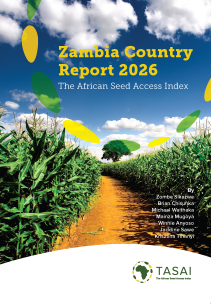
The 2026 TASAI Zambia Country Report presents findings from the second assessment of Zambia’s formal seed sector. The study focuses on five grain and legume crops important to Zambia’s food and nutritional security: maize, bean, sunflower, soya bean, and wheat. Wheat was added as a fifth focus crop because of its growing importance to the country. The study surveyed 39 of the 40 active seed producers and complemented industry responses with administrative data from the Seed Control and Certification Institute (SCCI) and the Ministry of Agriculture.
Zambia has a relatively strong formal seed industry and is an important seed producer and exporter within the region. However, access to improved seed remains uneven across crops. Improved-seed adoption is highest for maize, at 69%, followed by soya bean at 36%, sunflower at 17%, and bean at 11%. The report points to a sector with strong private-sector participation, active research and variety development, and growing regional trade, while highlighting persistent challenges around seed quality, distribution, extension services, affordability, and counterfeit seed.
Under the Research and Development category, Zambia has a strong private-sector presence in plant breeding. The study identified 52 active breeders across the five focus crops, of whom 43 were in the private sector and nine in the public sector. Between 2023 and 2025, 69 varieties were released, including 49 maize, nine bean, five soya bean, five wheat, and one sunflower variety. The private sector accounted for 63 of these releases. Most of the recently released varieties also have special traits, with 50 of the 69 varieties classified as climate smart. However, stakeholders raised concerns about the infrequent release of new public maize varieties, limited collaboration between seed companies and public wheat breeders, and the quality of basic seed for sunflower.
Under Industry Competitiveness, Zambia’s seed industry is characterized by substantial private-sector participation and significant production capacity. SCCI reported 178,515 metric tons of certified maize seed produced in 2024/25, reinforcing Zambia’s position as a major maize seed producer in the region. Zambia also exported 92,307 metric tons of seed through 955 export transactions to 31 countries, including 88,381 metric tons of maize seed to 26 countries and 3,704 metric tons of soya bean seed to 15 countries. The country had 40 active seed producers, 39 of which took part in the TASAI survey, and there was no government-owned seed company. Competition is relatively strong in the bean, sunflower, and soya bean markets. The maize market sits at the lower boundary of moderate concentration, with the top four companies holding 76% of estimated sales, while the wheat seed market, with only five active producers, is extremely concentrated.
Under Seed Policy and Regulations, Zambia has an established regulatory framework governing the production, certification, and distribution of seed. SCCI remains the national authority responsible for seed certification and quality control. Despite this framework, counterfeit and illegal seed remain a concern. SCCI recorded 36 cases and confiscated 24,023 metric tons of counterfeit or illegal seed, while seed companies reported 100 cases of counterfeit seed. The continued presence of counterfeit seed underscores the need for stronger enforcement and sustained awareness among farmers and other actors across the seed value chain. The report also notes that the Farmer Input Support Programme had fully transitioned to the e-voucher system in 2024/25. Seed producers rated procurement transparency at 72% and predictability at 70%, while payment efficiency received a lower rating of 53%.
Under Institutional Support, Zambia benefits from an active seed industry association and a seed inspection system that combines public and private inspectors. The Zambia Seed Trade Association (ZASTA), which had 33 members at the time of the study, has supported industry coordination through initiatives such as the annual Seed Congress, a multi-stakeholder platform addressing counterfeit seed, and a code of ethics for members. ZASTA’s overall performance was rated 69%, considered “good.” Seed inspection services received an overall rating of 72%, with 119 licensed inspectors in 2025, 77% of them private. Nevertheless, some seed companies indicated that the number of SCCI inspectors was insufficient to meet their needs.
Under Service to Smallholder Farmers, gaps in extension services and seed distribution continue to affect farmers’ access to quality seed. Zambia had 2,722 public extension officers and 4,741 private extension officers employed by seed producers. The public extension system was estimated at approximately one extension officer for every 1,700 farmers, compared with the FAO-recommended maximum ratio of one officer to 400 farmers. Public extension services received a “fair” rating of 57%, with stakeholders highlighting inadequate staffing and transport. The relatively low adoption of improved seed in crops such as bean, sunflower, and soya bean also points to the need for stronger farmer awareness, better distribution networks, and greater access to affordable quality seed.
Overall, the 2026 TASAI Zambia Country Report shows a formal seed sector with strong foundations for continued growth and regional leadership. Seed producers see the same strengths: a supportive policy environment, growing domestic demand, and expanding regional export markets. The challenges they raise most often are counterfeit seed, gaps in policy and regulation, and climate change. Meeting them will require stronger enforcement against counterfeit seed, clearer policies and regulations, and continued investment in research and development, including climate-resilient varieties. Investment in seed quality assurance, extension services, and farmer access will also be important to ensure that Zambia’s growing seed industry translates into greater use of quality improved seed by smallholder farmers.
The findings of the 2026 TASAI Zambia Country Report were presented to stakeholders at a dissemination meeting held in Lusaka on July 29, 2026. The report incorporates feedback received during the stakeholder engagement.