

TASAI Shares Kenya Seed Sector Findings at the 2026 STAK Annual Congres
November 11, 2026
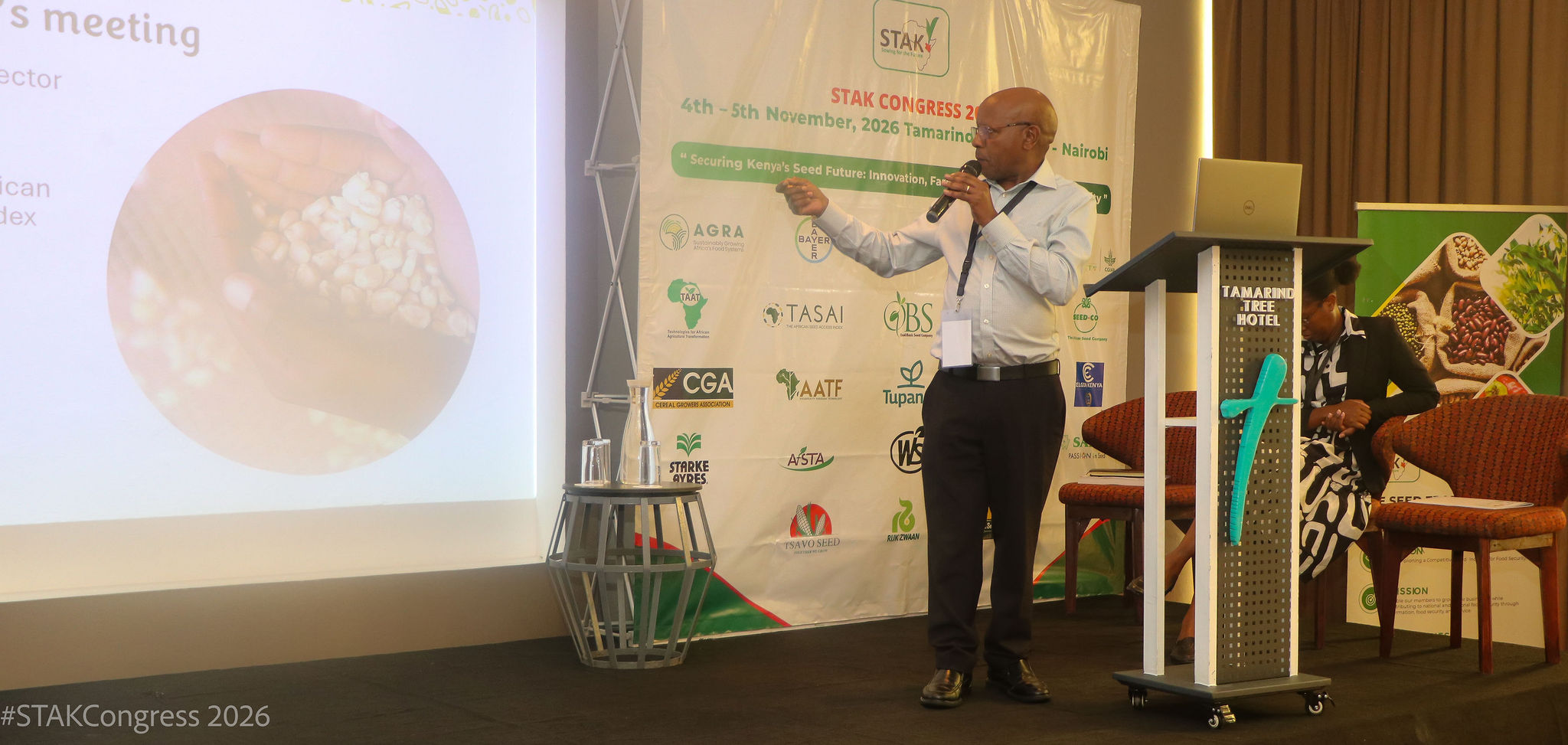
From November 4–5, 2026, The African Seed Access Index (TASAI) took part in the Annual Congress of the Seed Trade Association of Kenya (STAK), held at the Tamarind Tree Hotel in Nairobi under the theme “Securing Kenya’s Seed Future Through Innovation, Farmer Protection and Food Security.” Alongside the congress, TASAI presented the findings of the 2025 TASAI Kenya Country Study to seed sector stakeholders. TASAI was represented by Dr. Michael Waithaka, Chief Editor, and Jackline Sawe, Program Assistant.
The congress was officially opened by Mr. James Wanjohi, Agriculture Secretary, Ministry of Agriculture and Livestock Development. In her opening remarks, STAK Chair Ms. Betty Kiplagat set out the association’s priorities for the sector: stronger action against counterfeit seed, zero-rating of the 16% Value Added Tax (VAT) on vegetable seed, equitable participation of seed companies in the government seed subsidy programme, separate legislation within the ongoing seed law review, and resolution of pending court cases on biotechnology.
About 100 participants attended, representing seed companies, government, regulators, research institutions, development partners and regional bodies. Speakers included representatives of the Ministry of Agriculture and Livestock Development (MoALD), the Executive Office of the President, the Kenya Plant Health Inspectorate Service (KEPHIS), the African Seed Trade Association (AFSTA) and the African Union Inter-African Phytosanitary Council (AU-IAPSC).
Sharing the 2025 Kenya Country Study
On November 5, 2026, Dr. Waithaka and Dr. Mercy Mburu, Project Account and Research Manager at the Africa Centre of Excellence on Sustainable Operations for Resource Management and Food Supply, University of Nairobi presented the findings of the 2025 TASAI Kenya Country Study to about 40–50 participants. Dr. Waithaka also gave a snapshot of the 2025 African Seed Sector Performance Index (ASSPI) Status Report.
Participants offered valuable feedback on the study, including suggestions to:
- recognize the contribution of CGIAR breeders to variety development in Kenya;
- consider Irish potato as a priority crop in future studies;
- refine how the contribution of extension services to the seed sector is measured;
- publish reports closer to the period of data collection;
- track the commercialization of newly released varieties.
Policy and Regulatory Reforms
KEPHIS reported that it certified 80,848 metric tons of seed in 2025. Between 2023 and 2024, it intercepted 114 metric tons of counterfeit seed, leading to 36 court cases and 19 convictions.
KEPHIS also presented draft amendments to Kenya’s seed legal framework. Proposals include recognition of community seed systems, clarification of farmers’ rights to save seed and the limits of plant breeders’ rights, a greater role for county governments, expansion of the National Variety List into a National Variety Index, a national strategic seed reserve, and a Plant Genetic Resources Institute. A moderated debate on farmers’ and breeders’ rights concluded that the revised law must balance both and provide legal certainty.
Key Outcomes and Insights
Other sessions covered regional seed trade and plant health, plant variety protection, counterfeit seed and digital verification, the commercialization of new varieties, shared services, data and digitalization, gene editing, and women in the seed sector. In its presentation on agricultural investment and public-private partnerships, the American Chamber of Commerce (AmCham) Kenya drew on the 2022 TASAI Kenya Country Report.
TASAI is grateful to STAK for providing a platform to share the study’s findings, and to all stakeholders who contributed their insights.
Through this work, TASAI continues to generate evidence that supports competitive seed sectors and improves smallholder farmers’ access to quality seed.