

Our Story
What We Do
The Challenge
Seed systems are critical to improving food and nutrition security, resilience, and livelihoods of smallholder farmers in Africa. In countries with well-functioning seed systems, the private sector is at the forefront of development. In contrast, in many African countries, progress towards a vibrant, private sector-led seed system has been slow due to weak enabling environments – the “set of policies, institutions, support services and other conditions that collectively improve or create a general business setting where business activities can start, develop and thrive.”
As a result, African smallholder farmers (the ‘end users’ in the seed system) lag behind their counterparts in other countries in terms of access to new and improved varieties that respond to the challenges of food and nutritional security and climate change.
The Solution
The solution offered by TASAI is an analytical tool that harnesses data to offer an accurate and comprehensive picture of a country’s seed sector. The information allows decision-makers in the public and private spheres to build and maintain competitive seed systems that give African smallholder farmers improved access to locally adapted, affordable, and high-quality seed of improved varieties.
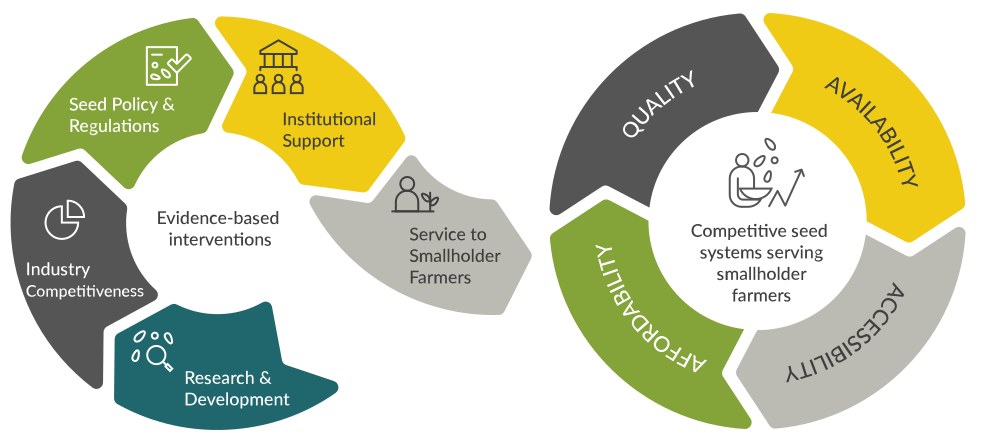
To generate a comprehensive picture of a country’s seed sector, TASAI studies collect data on 22 indicators in 5 areas: Research and Development, Industry Competitiveness, Seed Policy and Regulations, Institutional Support, and Service to Smallholder Farmers. Using TASAI data allows decision-makers to develop evidenced-based interventions designed to achieve the four outcomes of competitive seed systems: availability, accessibility, affordability, and quality.
For a specific crop variety availability means that all seed classes are available in sufficient quantities to meet existing demand. Varieties should be agro-ecologically adapted and responsive to farmers’ needs.
For seed to be accessible, enough delivery channels must be in place to reach smallholder farmers. Additionally, farmers need adequate information on varieties and a sufficient number of outlets to make informed seed purchase choices.
Affordability means that seed varieties are affordable for most smallholder farmers. Further, seed should be available of seed in package sizes that allow smallholder farmers to purchase smaller quantities at a time.
The seed available must be of a quality that meets the farmers’ expectations, the labeled specifications, and the regulated standards. Further, to promote accountability, well-functioning seed systems have redress mechanisms for farmers to report if the seed does not perform to the stated standard.
Theory of Change
Our Theory of Change rests on the assumption that accurate and comprehensive data are essential to the success of interventions that are building competitive seed systems. TASAI defines a competitive seed system based on its ability to deliver the following outcomes for farmers: Availability, Accessibility, Affordability, and Quality.
Who Uses TASAI?
TASAI is used by practitioners in the public sector, private sector, and development agencies to both inform and compel change.
Public Sector: The primary audience for TASAI is public policy makers, regulators, and law enforcement agencies involved in the seed system value chain. Implementing institutions such as ministries of agriculture, seed inspection services, and agricultural research institutions also use TASAI to benchmark their performance.
Private Sector: TASAI data have been used by seed companies and other value chain players to identify investment opportunities in the African seed value chain.
Development Agencies: For NGOs and other development agencies working in rural agricultural development, TASAI data highlight gaps that impede access to improved seed by smallholder farmers and that actions by donor agencies may focus on.
Who We Are
The African Seed Access Index (TASAI) was born as a project in 2011 to provide country-level assessments of the seed industry in Africa. In October 2019, TASAI Inc., a nonprofit (501(c)(3)) organization, was launched to coordinate all TASAI activities.
TASAI has a dedicated core team, whose members are based in Africa (Kenya, Niger, Uganda, and Zimbabwe) and North America (Ithaca, NY and Chicago, IL, USA). In addition, we work with close to 50 seed industry experts in 25 countries, who are engaged as researchers in the TASAI studies for their respective countries.
Our Values: Our activities are governed by our Code of Ethics and our overarching mission to find solutions to urgent problems in agricultural development in developing countries (to date in Africa). TASAI’s work supports several UN’s Sustainable Development Goals (SDGs) that focus on the elimination of poverty, hunger, and finding sustainable solutions to environmental problems.